---
title: 'Chess and Recursion: Part 1'
layout: post
categories:
- blog
- coding
- development
- elixir
- games
date: Fri, 10 Aug 2018 00:00:00 +0000
image: "blog/chess-and-recursion-part-1/escher-chess.jpg"
---
{{< img src="escher-chess.jpg" alt="My custom keyboard" caption="" >}}
I’ve been using my investment time at thoughtbot to build a multiplayer chess
game using Elixir and Phoenix in order to hone my skills in that area. One of
the trickiest and most fun parts of the project so far has been generating all
the possible moves for a player to make.
### The board
We will store the board as a map of pieces indexed by their position as a tuple.
This makes it easy to move pieces around the board by popping elements out of
the map and then adding them back in with a new index.
```elixir
%{
{0, 7} => %{type: "rook", colour: "black"},
{1, 7} => %{type: "knight", colour: "black"},
{2, 7} => %{type: "bishop", colour: "black"},
{3, 7} => %{type: "queen", colour: "black"},
{4, 7} => %{type: "king", colour: "black"},
{5, 7} => %{type: "bishop", colour: "black"},
{6, 7} => %{type: "knight", colour: "black"},
{7, 7} => %{type: "rook", colour: "black"},
{0, 6} => %{type: "pawn", colour: "black"},
{1, 6} => %{type: "pawn", colour: "black"},
# rest of the pieces ...
}
```
### Linear moves
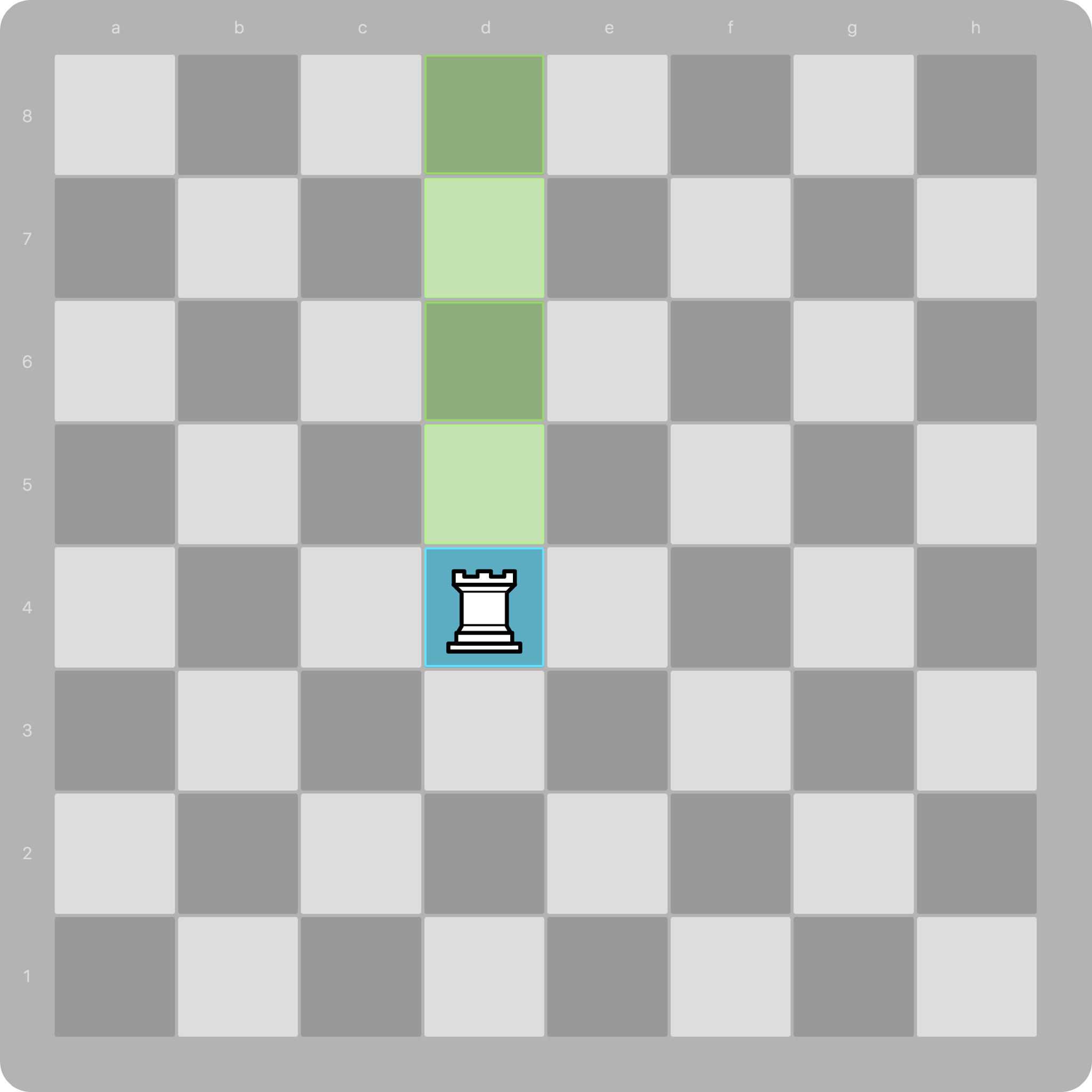
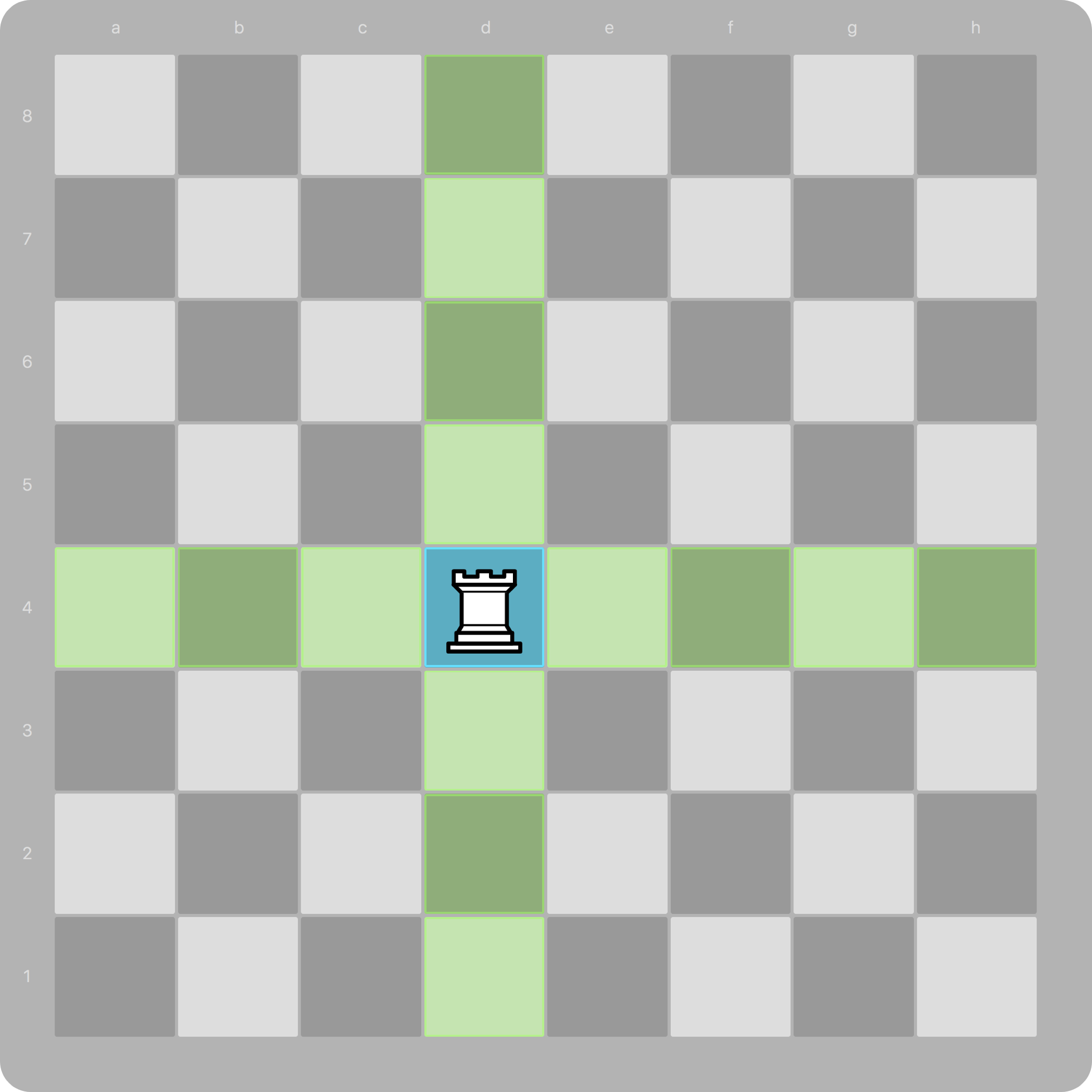
We’ll start this journey with rooks as they have a relatively straightforward
movement profile. For now we will ignore blocking pieces which means that for
each direction we just need to traverse the board in one direction until we hit
the edge.
Looping in Elixir is achieved through recursion. This may sound complex but has
some advantages as we will see.
Here’s a function that will return all the available moves in one direction:
```elixir
# lib/chess/moves/rook.ex
defmodule Chess.Moves.Rook do
def moves_north(_board, {_file, 7}), do: []
def moves_north(board, {file, rank}) do
[{file, rank + 1} | moves_north(board, {file, rank + 1})]
end
end
```
Let's break this down piece by piece.
We're using Elixir's pattern matching to define multiple functions here with the
same name. If you'd like to read more about Elixir's pattern matching I would
recommend [Pattern Matching in Elixir: Five Things to
Remember](https://blog.carbonfive.com/2017/10/19/pattern-matching-in-elixir-five-things-to-remember/)
by Anna Neyzberg
The first function matches if the `rank` is 7. This means we've hit the top edge
of the board so we return an empty list to stop the recursion.
```elixir
def moves_north(_board, {_file, 7}), do: []
```
(The underscores in front of the variable names indicate that we can discard the
values as we don't need them in the function definition.)
Lists in Elixir are represented internally as linked lists. They are represented
internally by pairs consisting of the head and the tail of the list. The `|`
operator allows us to match the head and tail of a lists or construct a new list
from a head and a tail.
The next function returns a new list with the head containing the next square
north and the tail being the result of another call to this function:
```elixir
def moves_north(board, {file, rank}) do
[{file, rank + 1} | moves_north(board, {file, rank + 1})]
end
```
Essentially we are adding `1` to the rank until it reaches `7`, then unwinding
the stack and returning the resulting list. If `rank` starts at say `4` (we’ll
set `file` to `0`) then we get this back from the recursive function:
```elixir
[{0, 4} | [{0, 5} | [{0, 6} | [{0, 7}]]]]
```
Which is equivalent to:
```elixir
[{0, 4}, {0, 5}, {0, 6}, {0, 7}]
```
And there we have our list of moves in one direction!
We can create other recursive functions to handle moving south, east and west:
```elixir
def moves_south(_board, {_file, 0}), do: []
def moves_south(board, {file, rank}) do
[{file, rank - 1} | moves_south(board, {file, rank - 1})]
end
def moves_east(_board, {7, _rank}), do: []
def moves_east(board, {file, rank}) do
[{file + 1, rank} | moves_east(board, {file + 1, rank})]
end
def moves_west(_board, {0, _rank}), do: []
def moves_west(board, {file, rank}) do
[{file - 1, rank} | moves_west(board, {file - 1, rank})]
end
```
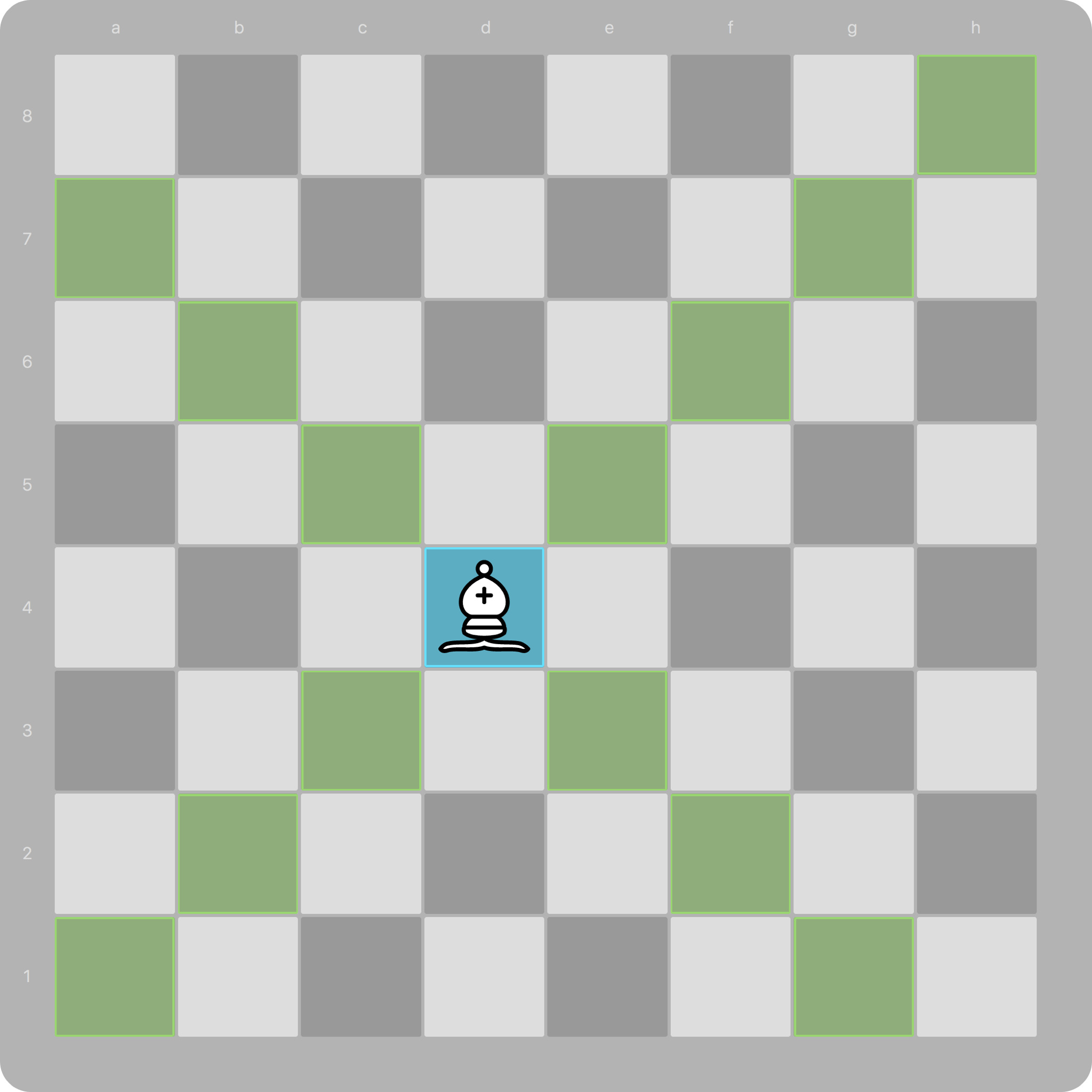
We can even start writing functions to handle moving in diagonal directions, for
bishops and queens:
```elixir
def moves_northeast(_board, {7, _rank}), do: []
def moves_northeast(_board, {_file, 7}), do: []
def moves_northeast(board, {file, rank}) do
[{file + 1, rank + 1} | moves_northeast(board, {file + 1, rank + 1})]
end
```
We're writing a lot of functions now that look very similar, so let's figure out
a better way.
Each of these functions is doing the same thing—moving in a straight line—just
in a different direction. We could pass an offset vector as a tuple instead of
hard coding it into each function, so if we want all the moves north we could
call it like this:
```elixir
moves(board, {3, 4}, {0, 1}) # (board, position, vector)
```
The main body of the function looks like this:
```elixir
def moves(board, {file, rank}, {fv, rv}) do
next_square = {file + fv, rank + rv}
[next_square | moves(board, next_square, {fv, rv})]
end
```
We need to match cases where we hit the edge of the board and stop the
recursion:
```elixir
def moves(_board, {0, _rank}, {-1, _}), do: []
def moves(_board, {_file, 0}, {_, -1}), do: []
def moves(_board, {7, _rank}, {1, _}), do: []
def moves(_board, {_file, 7}, {_, 1}), do: []
def moves(board, {file, rank}, {fv, rv}) do
next_square = {file + fv, rank + rv}
[next_square | moves(board, next_square, {fv, rv})]
end
```
### Obstructions
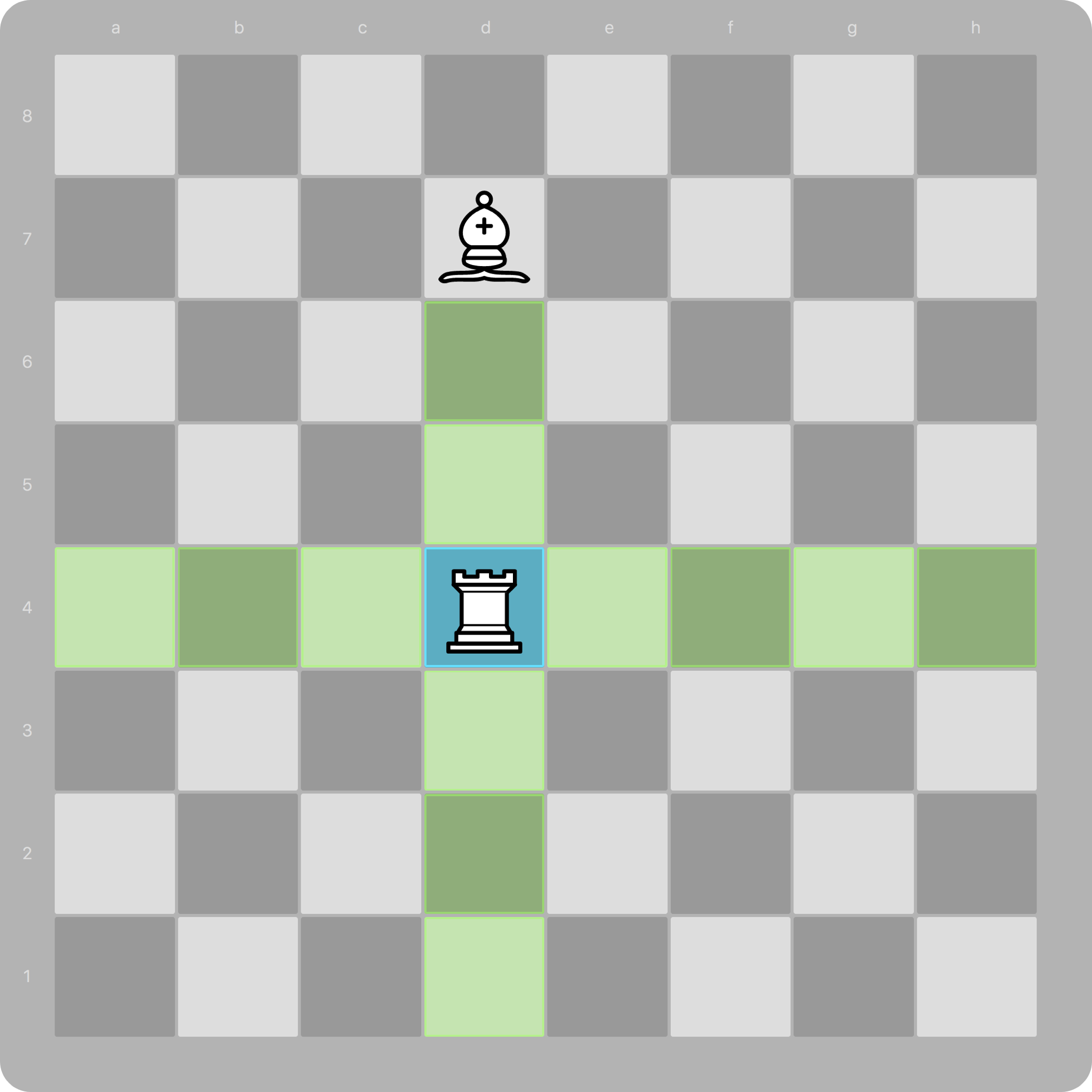
We need to handle cases where another piece is in the way. First, let’s define
a function that will tell us if a square is empty:
```elixir
# we'll use defp to define a private function as
# we won't be calling this outside of this module.
defp empty?(board, position) do
is_nil(board[position])
end
```
Now we can use this function in our moves function to only recurse if the next
square is empty. If the square is not empty then we return an empty list to stop
recursion.
```elixir
def moves(board, {file, rank}, {fv, rv}) do
next_square = {file + fv, rank + rv}
if empty?(board, next_square) do
[next_square | moves(board, next_square, {fv, rv})]
else
[]
end
end
```
### All together now
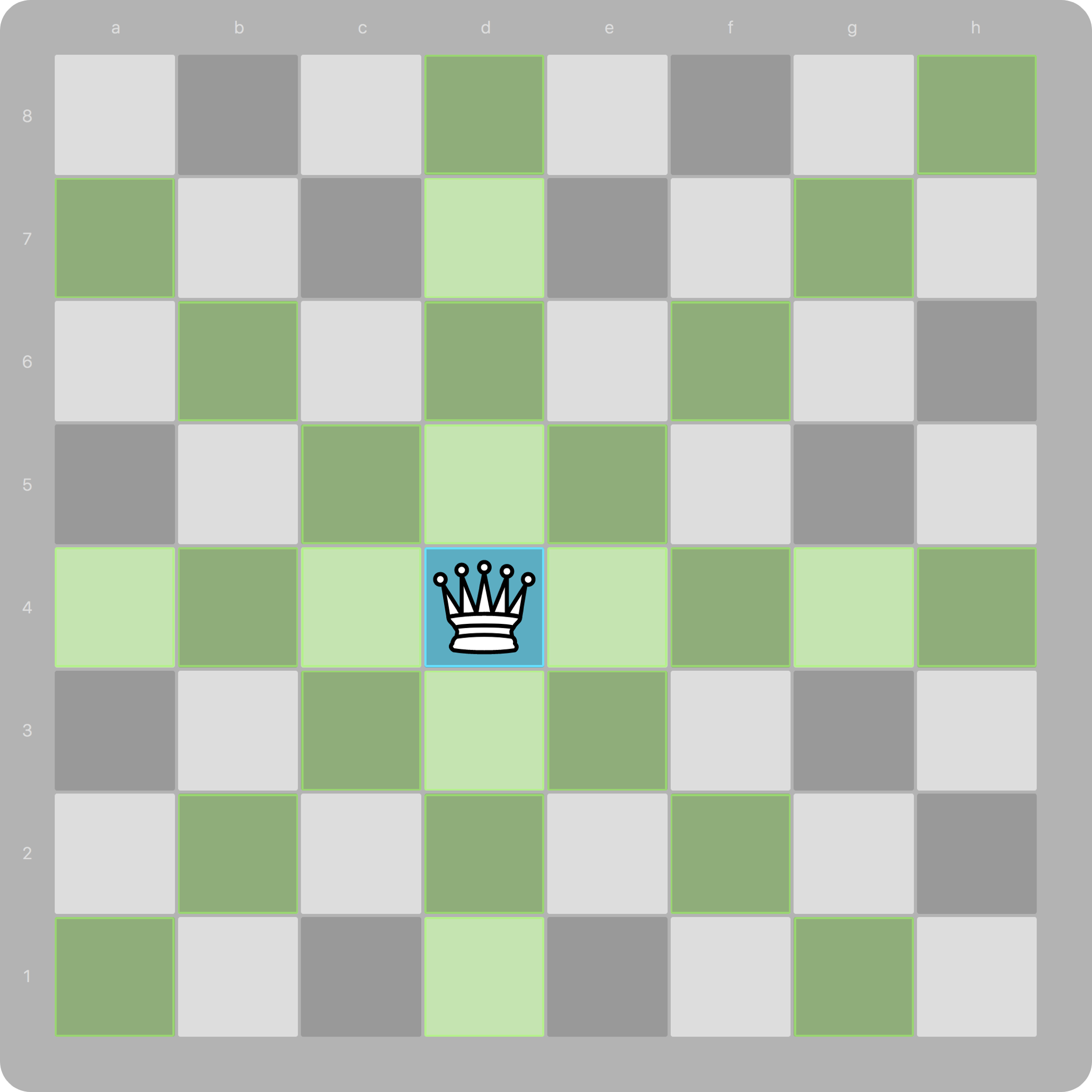
Lastly, let’s combine these to generate moves for all the pieces that move in
straight lines:
```elixir
defmodule Chess.Moves do
def queen(board, position) do
# The queen moves like both a rook and a bishop
rook(board, position) ++
bishop(board, position)
end
def rook(board, {file, rank}) do
moves(board, {file, rank}, {0, 1}) ++
moves(board, {file, rank}, {0, -1}) ++
moves(board, {file, rank}, {-1, 0}) ++
moves(board, {file, rank}, {1, 0})
end
def bishop(board, {file, rank}) do
moves(board, {file, rank}, {1, 1}) ++
moves(board, {file, rank}, {1, -1}) ++
moves(board, {file, rank}, {-1, 1}) ++
moves(board, {file, rank}, {-1, -1})
end
defp moves(_board, {0, _rank}, {-1, _}), do: []
defp moves(_board, {_file, 0}, {_, -1}), do: []
defp moves(_board, {7, _rank}, {1, _}), do: []
defp moves(_board, {_file, 7}, {_, 1}), do: []
defp moves(board, {file, rank}, {fv, rv}) do
next_square = {file + fv, rank + rv}
if empty?(board, next_square) do
[next_square | moves(board, next_square, {fv, rv})]
else
[]
end
end
defp empty?(board, position) do
is_nil(board[position])
end
end
```
That’s all for now, next time we’ll tackle the gnarly moves of the knight!
If you’re impatient for more, you can always check out the source code on GitHub
at [https://github.com/danbee/chess](https://github.com/danbee/chess).
*This post was also published to the [thoughtbot
blog](https://robots.thoughtbot.com/chess-and-recursion-part-1).*